






 Spell
 Continuous
Dark Room of Nightmare
View:
1497
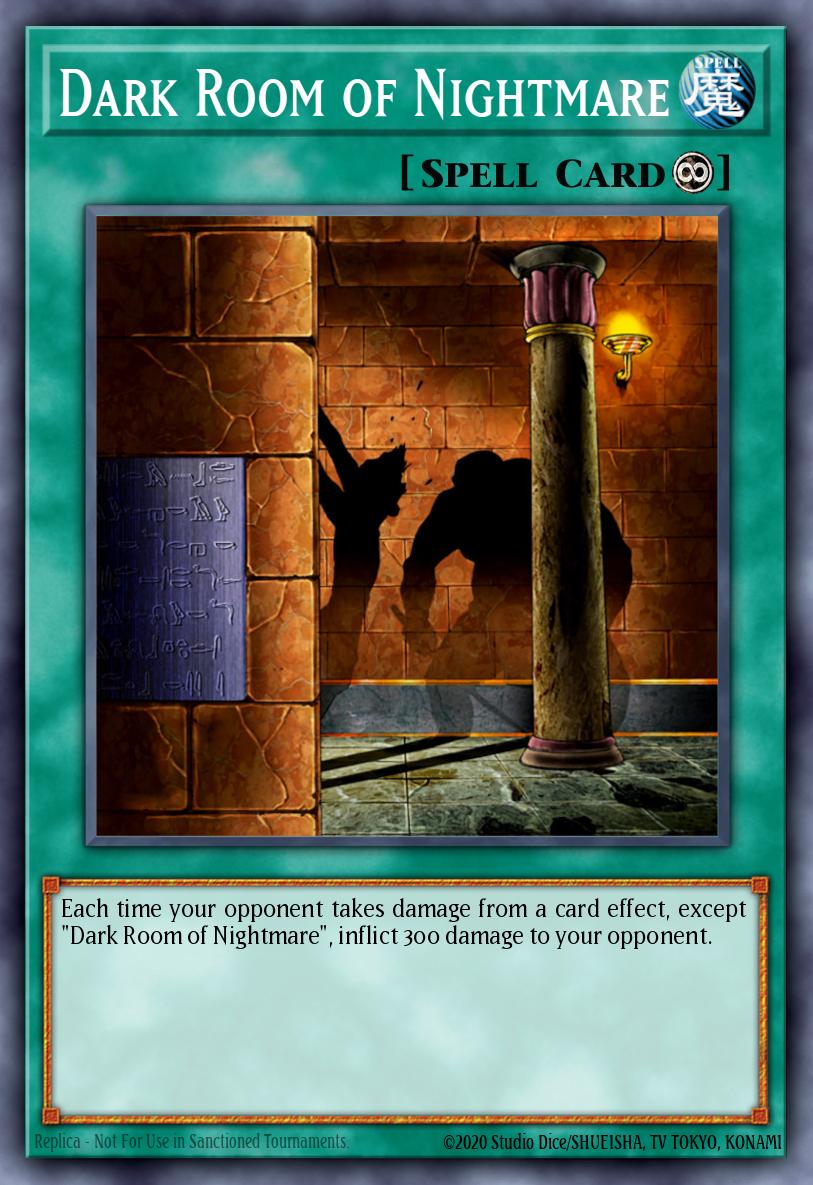
Each time your opponent takes damage from a card effect, except "Dark Room of Nightmare", inflict 300 damage to your opponent.

Dark Room of Nightmare — Power Evaluation
Final Score: 50 ± 8 · Confidence: Medium
- Intrinsic: 49 · Deck: 51 · Meta: provisional
- Primary role: Utility · Secondary: Boss/End-board
Why it scores here
Dark Room of Nightmare is a Continuous Spell that converts every effect-damage event the opponent takes into 300 damage, so its value depends on the deck generating effect damage, not on its own body. Its presence in 236 recent decks (about 2.4 copies each, 53 distinct archetypes, led by Trickstar with high co-occurrence with Trickstar partners) shows it is reliably accessible and played in practice, which earns the accessibility score. It has no opponent interaction, no material value, and no card advantage, and it is vulnerable to removal as a Continuous Spell, so its score stays around the middle. High deck counts reflect the burn plan rather than intrinsic strength, so they were not used to inflate the score.
Axis scores
| Axis | Score | Evidence |
|---|---|---|
| Accessibility | 70 | 236 of the recent decks run it (decks running it in the Main Deck 236, avg 2.36 copies, 124 decks at 3 copies), spread across 53 archetypes with Trickstar the main home (observed). |
| Combo & Conversion | 40 | Text converts each effect-damage event into 300 damage, but there are no combo boards in the evidence, so conversion is text-only (inferred). |
| Resource Economy | 45 | No draw, search, or recovery text; it is a pure damage-per-event engine with no card advantage (verified). |
| Effect & Interaction | 20 | No negation, removal, or hand-trap text; it does not interact with the opponent's plays beyond damage (verified). |
| Material Utility | 5 | A Spell card cannot be used as material and has no level, attribute, or name provider value (verified). |
| Resilience & Flexibility | 45 | A Continuous Spell stays on the field across turns but can be destroyed by generic removal and has no redundancy (inferred). |
| Deck-Building Efficiency | 70 | One slot with no garnet or lock restriction; DuelLinks legal copies are capped at 1, which limits redundancy in that format (verified). |
Calculation
Weight profile: 0.7 Utility + 0.3 Boss/End-board. Intrinsic ≈ 49, Deck ≈ 51, Meta = provisional. Modifiers: DuelLinks copy limit (-2). Final formula: 0.40*Intrinsic + 0.60*Deck
Strengths
- Converts each opponent effect-damage event into 300 damage, which adds up across a game
- Runs in 236 recent decks with 53 archetypes, so it is easy to fit into different homes
- Costs one slot and has no garnet or lock restriction
Weaknesses
- Does nothing without an effect-damage engine on the board
- No opponent interaction, card advantage, or material value
- Continuous Spell that can be destroyed by generic removal
Counters / choke points
- Generic spell or continuous-card removal
- Decks that avoid effect damage (the card's payoff never triggers)
Best use
Damage-engine add-on in effect-damage decks. Decks: Trickstar burn / waifu burn lists. Suggested copies: 2.
Evidence & gaps
- Verified: Text: each opponent effect-damage event inflicts 300 damage, excluding itself; Continuous Spell with no material or level value; 236 decks run it, averaging 2.36 copies; legal copies duellink = 1
- Observed: Trickstar is the dominant archetype home (67 + 44 decks); Co-occurrence with Trickstar partners ranges from 35% to 67% of decks; Gameplay type split: 49.6% type 4, 36.9% type 7
- Inferred: Accessibility is high because it is live in most decks that run it; Its value depends on the effect-damage engine in the deck; Removal risk comes from its Continuous Spell type
- Data gaps: no combos supplied — combo conversion is text-only inference no usage statistics (StatisticsCard) — archetype inclusion % inferred from deck sample only no combo boards, so starter role, payoff role, and power index are unavailable gameplay type ids are not mapped to names